
China–Ethiopia Relations and Industrial Development: What Went Wrong?
Over the past two decades, Ethiopia has pursued an ambitious goal: to become Africa’s light manufacturing hub and reach lower middle-income status by 2025. Inspired in part by China’s state-led development model, Ethiopian leaders embraced industrial policy, special economic zones, and export-oriented manufacturing as the path to transform. For a while, the story looked promising. Ethiopia recorded doble-digit economic growth between 2004 and 2017. Industrial parks proliferated across the country, investment from China poured in, and the Ethiopian “developmental state” model was commended by international organizations. But how far has that project really gone?
In a recent contribution to PS: Political Science & Politics, “China-Ethiopia Relations and Industrial Development: A Brief Evaluation”, John H.S. Åberg and Haftom Bayray Kahsay take a critical evaluation at the China‒Ethiopia relations and Ethiopia’s industrial development. The authors argue that despite the impressive growth figures, Ethiopia has not become a manufacturing powerhouse. Instead, structural transformation remains limited, and the economy became fragile, and deeply vulnerable.
Let us examine why: Ethiopia’s development strategy was heavily influenced by China’s rapid industrialization. Policymakers drew ideas associated with Justin Lin, particularly his theory of New Structural Economics. Lin himself pointed to Ethiopia as an ‘excellent example’ of how late industrializers could take off.
Under Ethiopia’s Growth and Transformation Plans (GTP), the government:
§ Built industrial parks across the country
§ Targeted labor-intensive export oriented light manufacturing industries
§ Attracted foreign direct investment (FDI), especially from Chinese firms
§ Focused on exports to global markets
Under these GTP plans, for a time, the macro-economic figures looked promising. From 2004 to 2017, Ethiopia recorded a double-digit GDP growth. International observers praised the country as a potential African success story. But GDP growth alone does not guarantee industrial transformation.
Growth targets and industrial reality
Ethiopia’s Growth and Transformation Plan II (GTP II) set a macroeconomic and sectoral targets, especially in manufacturing and exports. These are summarized in Table 1 below.
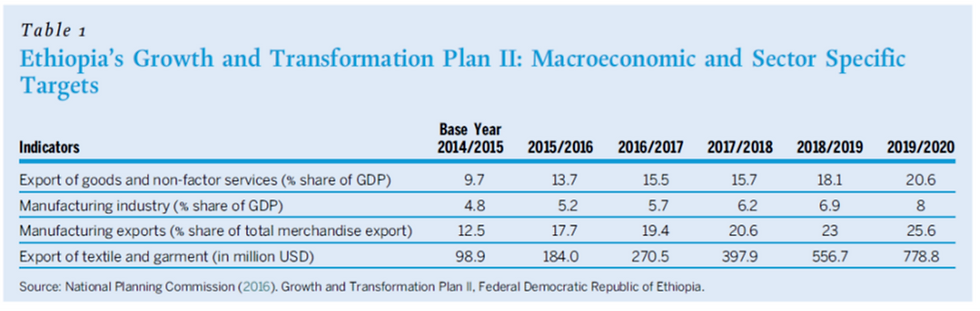
The gap between target and outcome is striking. The export of textiles and garments is about $156 million- far below the 2020 target of nearly $779 million. Manufacturing value added as percent of GDP remains 4%, which is far below the sub-Saharan Africa average. Meanwhile, agriculture continues to employ approximately two-thirds of the labor force.
The authors’ central claim is not that Ethiopia has failed to grow – GDP expanded rapidly between 2004 and 2017, but that growth has not yielded meaningful structural transformation. The economy remains dependent on primary commodity exports such as coffee and sesame, and manufacturing remains shallow and externally dependent.
Politically allocated industrial parks
The core of Ethiopia’s development problems is the contradiction between forces of centralization, connected to the government’s national development plans, and forces of
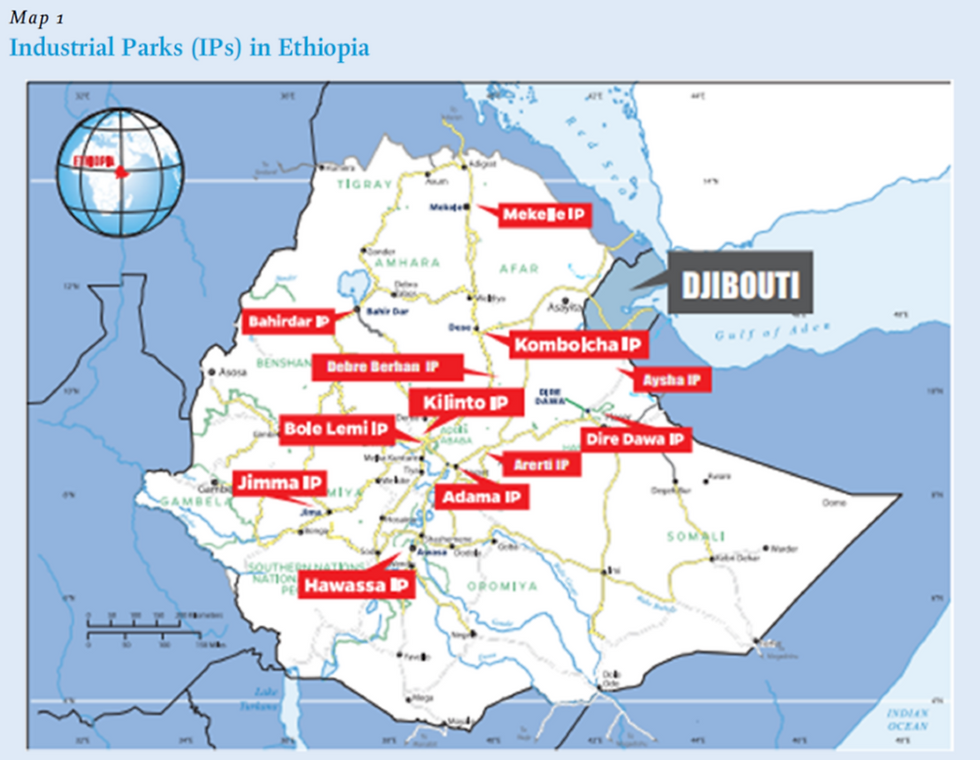
decentralization, nurtured by Ethiopia’s federal constitutional structure that grants extensive regional autonomy. Industrial parks were the central part of the strategy. They were built across the country to attract investors and boost exports. However, the authors argue that the geographical distribution of these industrial parks followed political logic rather than economic logic. As indicated in Map 1, instead of clustering parks where infrastructure, suppliers, or logistic would maximize efficiency, the government distributed them across federal regions – partly to balance political interests. This approach weakens economics of scale and industrial linkages.
Source: Ethiopian Investment Commission 2017 report on IPs incentive package. Available at https://www.unido.org/sites/default/files/files/2018-05/2.%20Industial%
20Parks%20Incentives.pdf.
Weak domestic backward linkages and dependence on foreign suppliers
Most firms operating in Ethiopia’s parks engage in low value-added “cut, make and trim” (CMT) garment assembly. They import yarn, textiles, and intermediate goods, assemble products using low-wage labor, and export finished goods to Western markets. Backward linkages to domestic suppliers remain minimal.
This structure limits knowledge spillovers, technological upgrading, and domestic firm development. Unlike the historical experience of South Korea or Taiwan – where industrial policy fostered local supplier networks – Ethiopia’s parks are heavily dominated by foreign firms operating within global value chains. Industrial parks are thus not catalysts for wider industrialization; instead, they are spatial enclaves disconnected from the domestic and regional economy yet connected to global markets and dependent on external forces.
Overreliance on preferential trade regimes
The deepening of China-Africa industrial ties and the attractiveness of Ethiopia as an investment destination partly depend on incentives provided by core Western states through their institutional arrangements, such as the Africa Growth and Opportunity Act (AGOA). The authors suggest the overreliance of the model on preferential trade such as AGOA. They argue that the vulnerability of the model became clear when Ethiopia lost its eligibility under the US Africa Growth and Opportunity Act (AGOA) during the Tigray conflict. The immediate effects included factory closures, falling production capacity in Hawasa Industrial Park, and significant layoffs. The dependence on preferential trade regimes exposed the narrowness of Ethiopia’s export base. Rather than diversified market integration, firms were often tied to single export destinations.
High labor turnover, Infrastructure gaps, and Political instability
In addition to the above problems, the authors outline the following three additional constraints that compound the problem. First, infrastructure remains unreliable despite substantial public investment. Electricity interruptions, logistic bottlenecks, and foreign currency shortages undermine competitiveness. Second, labor turnover is extraordinarily high. Studies cited in the article show that a significant share of workers quit within months, although there is encouraging evidence showing that manufacturing labor productivity has been improving over the past decade. Low wages, harsh working conditions, and limited upward mobility weaken workforce stability and skill accumulation. Third, political instability has eroded one of Ethiopia’s former advantages: perceived stability. The civil war in Tigray, ethnic tensions, and broader unrest have deterred investment and closed industrial facilities. Developmental states require not only planning capacity but also political cohesion. Ongoing conflict undermines both.
Conclusion
The article evaluates Ethiopia’s industrialization efforts, particularly its partnership with China. Inspired by the “developmental state” model and supported by China’s investment and policy advice, Ethiopia aimed to become a light manufacturing hub and lowe middle income country by 2025. The evidence presented by Åberg and Kahsay suggests that structural transformation remains elusive. Manufacturing is shallow and industrial linkages are weak. Ethiopia’s industrial strategy suffers from political allocation of industrial parks, few domestic linkages, heavy dependance on foreign inputs, and reliance on preferential trade regimes. Poor infrastructure, limited knowledge transfer, and higher labor turnover hinder productivity and growth. Despite intial economic gains, Ethiopia’s industrialization remains fragile, lacking structural trnsformation. War, civil strife, political instability, and intolerance further undermine investor confidence and development capacity.
John H. S. Åberg, Malmö University, Sweden
Haftom Bayray Kahsay, Department of Food and Resource Economics (IFRO), Copenhagen University, Denmark
Read more in our new article:
Åberg, John H.S and Kahsay, Haftom. B. (2025). China-Ethiopia Relations and Industrial Development: A Brief Evaluation. PS: Political Science and Politics, 58(3): 538-543. doi:10.1017/S1049096524001070


Comments